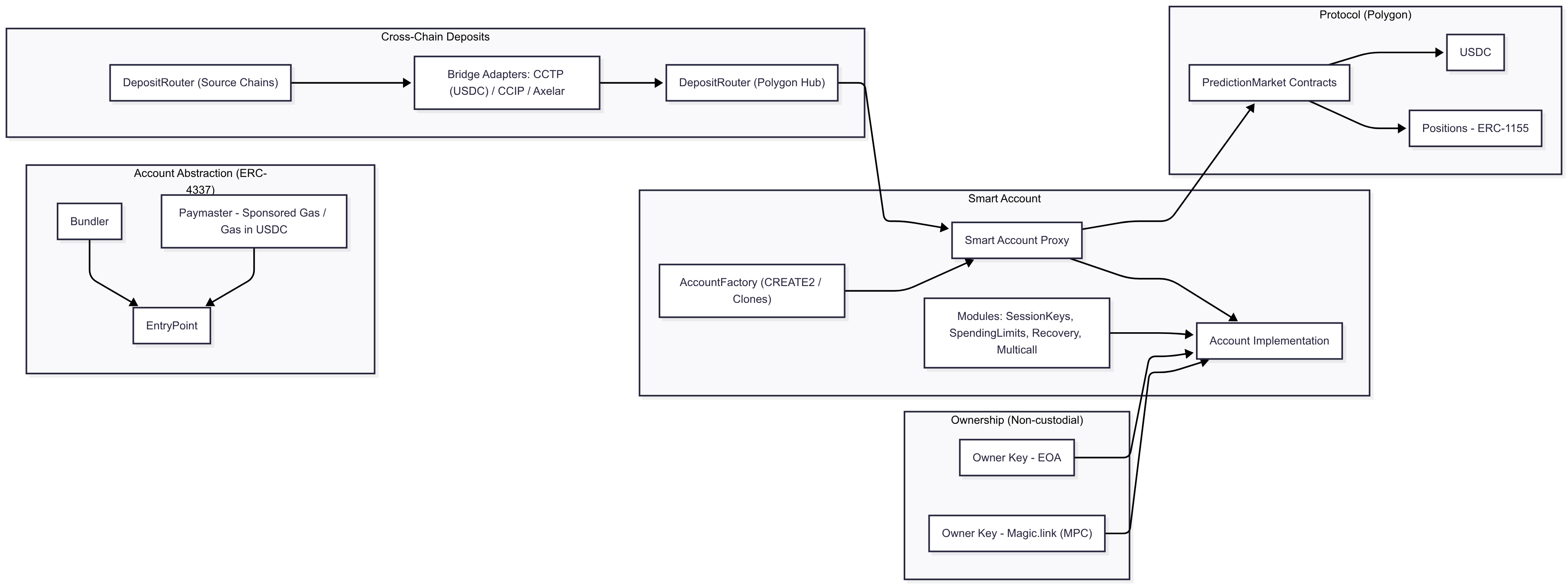
Wallet Architecture
Smart (Proxy) Wallet — What & How
What is a “Proxy Wallet” here?
- A non‑custodial smart account (a contract wallet) that belongs to the user but lives on‑chain.
- It uses Account Abstraction (ERC‑4337) so the account can:
- Bundle multiple actions into one transaction (approve + buy + stake, etc.).
- Use sponsored gas via a Paymaster (or pay gas in USDC).
- Use session keys, spending limits, and social recovery.
- It’s called “proxy” because we deploy a lightweight proxy (minimal proxy / EIP‑1167 or upgradeable proxy) that delegates logic to a single implementation contract.
- This makes deployment cheap (clones) and allows upgrades (with timelock & owner approval)
Ownership model (non‑custodial)
- The smart account is owned by the user’s key:
- Either EOA (MetaMask/Trust/WalletConnect)
- Or Magic.link key (MPC, non‑custodial).
- The platform never holds keys. Ownership & recovery modules are on‑chain.
When & how the wallet is created
- On signup, we derive a counterfactual address (via
CREATE2) for the user’s smart account—no gas spent yet. - On the first action (e.g., first trade/deposit), the AccountFactory deploys the proxy at that deterministic address and initializes:
- Owner(s) (EOA or Magic.link)
- Modules (session keys, recovery, spending limits)
- USDC as primary collateral and ERC‑1155 positions as holdings
- We maintain a Registry mapping
userId → smartAccountAddressper chain.
Where funds and positions live
- USDC collateral sits inside the user’s proxy wallet or inside the market contract/AMM while a trade is open.
- Market positions are ERC‑1155 tokens minted to the user’s proxy wallet address.
- Selling or winning credits USDC back to the proxy wallet.
Multi‑chain deposits (“Deposities”)
Goal: Let users send supported tokens (e.g., USDC) from several chains and have them available quickly for Polygon trading—without losing control.
Design (hub & spokes):
- Polygon is the hub where markets run and the proxy wallet primarily operates.
- Users may deposit on source chains they already hold assets on (e.g., Ethereum, Arbitrum, Base).
- A DepositRouter (source) contract accepts deposits and uses a Bridge Adapter:
- USDC: prefer Circle CCTP (burn/mint) for native USDC with minimal liquidity risk.
- Other tokens: use CCIP / Axelar adapters (configurable).
- On Polygon, a DepositRouter (hub) receives the bridged funds and credits the user’s proxy wallet.
Security & UX:
- Each deposit mints a DepositReceipt (event + id) for traceability.
- Replays are prevented by deposit nonce tracking.
- Timeouts/fallbacks if a bridge is congested.
- Notifications/Webhooks update UI when funds arrive.
Why bundling + paymaster matter
- With ERC‑4337, the user signs a UserOperation that can:
- Perform multi‑call: approve USDC → buy YES/NO → store receipt.
- Be sponsored so no MATIC is needed in the user wallet.
- Optionally pay gas in USDC via a paymaster policy.
- Result: Fast, single‑click trades, fewer signature popups, higher conversion.